
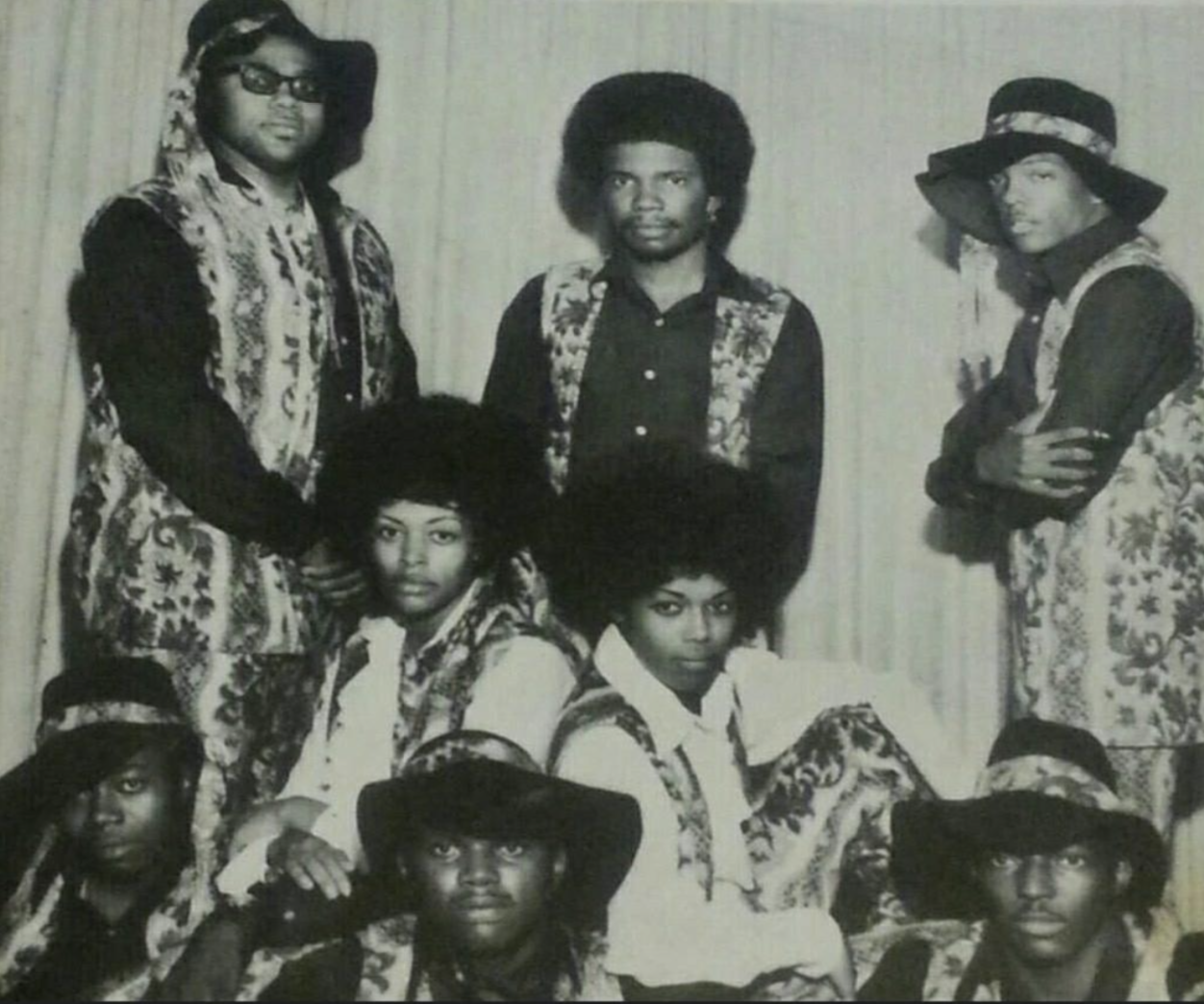
The Outback from Tulsa circa 1972 Front: Lee Thomas “LT” Wells (lead guitar), Reggie Cherry (bass guitar/vocals), Edward “Cha Cha” Cherry Jr. (B-3 organ) Middle: Vocalists – Lena Lucky (Wilson) and Rose Brewer (Minter) Back: James “Flab” Farley (sax), Roscoe Dabney III (drums), Charlie Wilson (lead vocals)
Roscoe Dabney III stands as one of the unsung architects of the Tulsa Sound, with his drumming and band leadership echoing through the city’s clubs and church halls. His journey through pioneering bands, the Magnificent Seven and Outback, helped shape Tulsa’s funk and soul legacy, leaving a mark that still resonates in the music and in the memories of those who lived it.
When most people think of the “Tulsa Sound,” they picture the laid-back shuffle of J. J. Cale or the gospel-tinged rock of Leon Russell. But that version of the story often leaves out the musicians who helped build its foundation long before the label existed.
Much of Tulsa’s Black musical history has been overlooked, even though the sound it produced never disappeared. Its influence can still be heard in hip-hop samples of The Gap Band’s grooves and in churches where musicians continue to learn and play with the same raw, unfiltered feel. Long before the Tulsa Sound became widely recognized, north Tulsa musicians were already shaping its foundation in neighborhood clubs and community spaces. Drummer Roscoe J. Dabney III—known to many as “Roach”—was part of that world.
Early Musical Beginnings
Born in 1946 in Lakewood, New Jersey, Roscoe Dabney III entered a family whose history blended military service, music, and perseverance. His father, Roscoe Dabney Jr., was a Tuskegee Airman whose singing talent nearly earned him victory over Tony Bennett on Arthur Godfrey’s Talent Scouts in 1949. Despite those accomplishments, family life was unstable. The marriage between Roscoe Jr. and Mary Louise Johnson ended when Dabney was still an infant. “My dad cheated on my mother when I was a baby,” Dabney recalled. “She wound up having to leave him.” His mother packed up and headed to Tulsa, where relatives offered support and familiarity. The move would shape the course of his life.
Much of Dabney’s childhood centered on the Small Hotel, a prominent Black-owned business near Greenwood and Archer. Listed in the Negro Motorist Green Book, it served as a refuge for Black travelers during segregation and became part of the Chitlin’ Circuit, a network of safe lodging and performance spaces. Well-known acts such as Count Basie and Duke Ellington’s bands, local bandleader Ernie Fields, and BB King stayed at the Small Hotel. As Greenwood rebuilt after the 1921 Tulsa Race Massacre, the hotel remained an important stop for traveling musicians, railroad workers, and professionals moving through the region.
Dabney’s mother worked the hotel switchboard while he absorbed the sounds and stories around him. Black railroad porters and dining car workers passing through Tulsa often treated him like family, nicknaming him “Little Rodney.” By the time he was six or seven, his stepfather, Sylvester “Syl” Nichols, encouraged his mother to let him travel with railroad workers between Tulsa and Kansas City. On those trips, Dabney sang for passengers, performing Frankie Lymon’s “Why Do Fools Fall in Love?” for tips—an early introduction to live audiences and performances.
The Small Hotel closed in 1963, and five years later, it was demolished as Interstate 244 cut through Greenwood as part of urban renewal, displacing many Black businesses again. With segregation still limiting travel accommodations, Dabney’s family opened their home on Newton Place to railroad workers and travelers passing through.
Music remained central in his life. “I would make sticks out of tree limbs and beat on furniture,” he said. His mother eventually agreed to drum lessons on one condition: he also study singing.
That decision led him to the Latimer School of Music above Latimer’s BBQ near Greenwood and Pine to study with Julia Latimer Warren, a Juilliard-trained musician who would later be honored for her outstanding career as an educator and gospel musician and inducted into the Oklahoma Jazz Hall of Fame. He sang in church, directed choirs, and built a disciplined musical foundation that would carry into his professional career.
North Tulsa’s Musical Traditions
Booker T. Washington High School served as the anchor of north Tulsa’s Black musical training, offering advanced instruction in theory, sight-reading, and orchestration. The school nurtured a deep musical culture in north Tulsa. The school produced musicians who would go on to regional and national careers, including Earl Bostic, Ernie Fields Jr., Wayman Tisdale, and Charlie Wilson.
Dabney joined the school’s marching band, a source of pride during the civil rights era, and began performing professionally with Little Lo & The Rest of Us, a blues group made up of Langston University students. The school provided training; the clubs provided opportunity.
During the 1950s and ’60s, north Tulsa was a creative crossroads for Black musicians. Guitarist Flash Terry was a central figure in the local blues scene, performing in clubs that drew Black audiences and visiting musicians from across town. Among those who came to listen were future Tulsa Sound figures J. J. Cale and Leon Russell, along with Jimmy Markham.
As teenagers, Cale and Russell crossed into north Tulsa to hear these musicians firsthand. Russell, in particular, became fascinated by the electric blues and rhythm-and-blues traditions flourishing there, including Flash Terry, which would shape his entire approach to production and performance. Years later, those musical circles overlapped again when Terry recorded Mr. Bluesman at Leon Russell’s Church Studio. The project even featured Western swing legend Leon McAuliffe of Bob Wills and the Texas Playboys, highlighting the remarkable blend of musical traditions that characterized Oklahoma music.
The Magnificent Seven – High Energy R&B
Inspired by the local scene, Dabney co-founded The Magnificent Seven, one of Tulsa’s leading R&B groups of the 1960s. Led by Dabney’s distant cousin, bassist Edward “Cha-Cha” Cherry, the band included musicians from Little Lo & The Rest of Us as well as classmates from Booker T. Washington High School.
In north Tulsa’s close-knit music community—shaped by church life, school programs, and family networks—joining a working band often required parental approval and community trust, especially for younger musicians. When the band sought to bring in trumpeter Ronnie Wilson, Dabney accompanied him to speak with Wilson’s family in person. Given the Wilson family’s standing in the community and the Church of God in Christ, their approval was essential. Ronnie’s mother, Irma Wilson, served as Oklahoma State Music Director for the denomination, while his father, O.W. Wilson, was a respected evangelist.
The effort paid off.
The group became a fixture at venues such as the Rose Room and the Big 10 Ballroom—both important stops on the Chitlin’ Circuit, where touring acts like Ray Charles, James Brown, and Tina Turner performed.
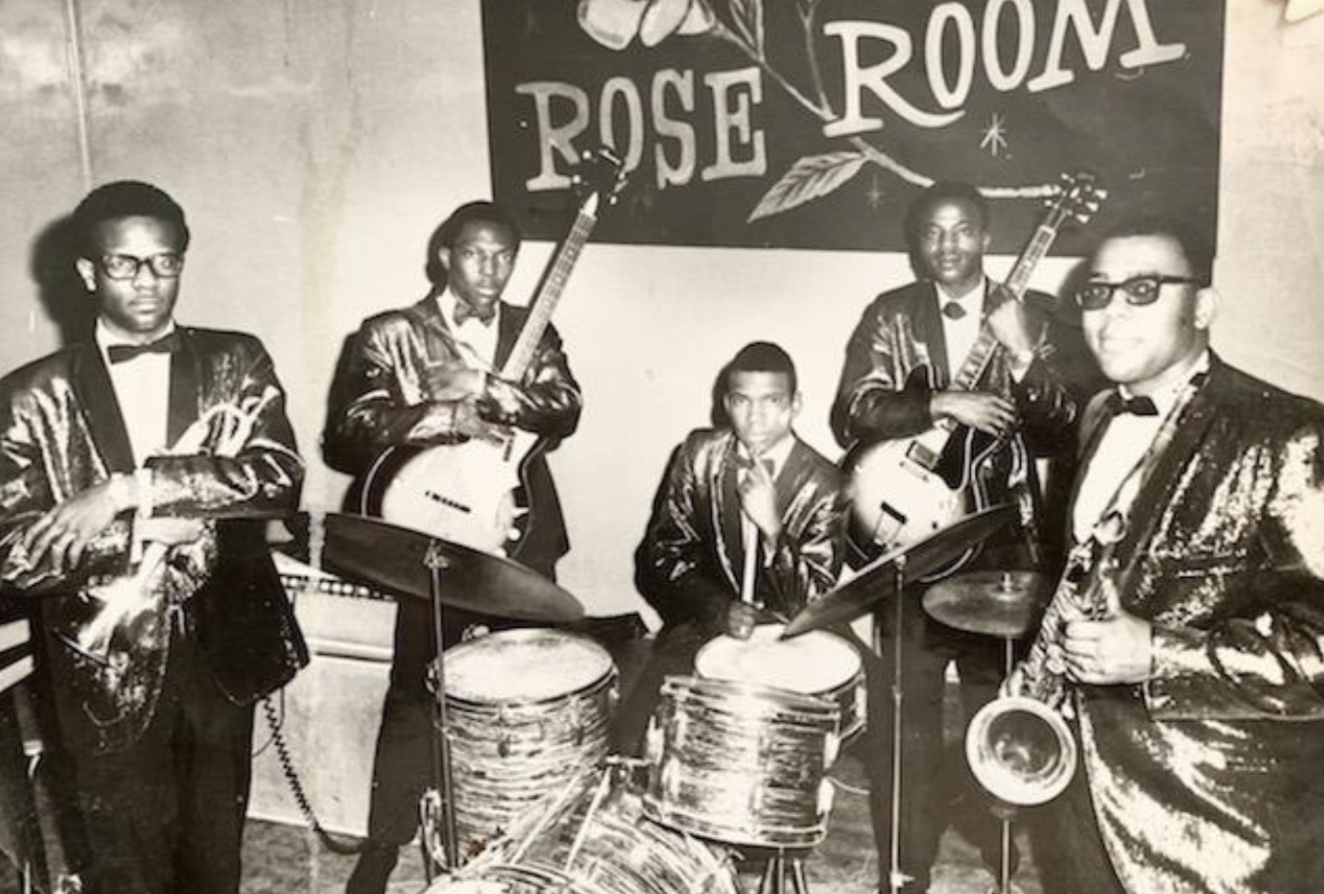
In 1966, the group recorded “Pluck-A-Pluck,” a driving, brass-heavy R&B single made for the dance floor. “We recorded it in an empty movie theater in Tulsa, the Regal Theater at Pine and Lansing,” Dabney said. The empty building’s natural acoustics gave the track a rich, reverberant sound. “A friend brought his reel-to-reel. We just recorded what we recorded. There were no tracks.” The band self-released the 45 RPM record. Today, collectors seek out rare copies.
Outback – Electric Psychedelic Funk
By the early 1970s, the group evolved into Outback, shifting toward psychedelic funk, soul, and jazz fusion. Dabney suggested the name after reading about Aboriginal Australian culture.
Their single “Strangers (In Our Homeland) / Reggie’s Thang” reflected both social commentary and musical experimentation, including the unusual use of two bass players performing simultaneously. Written by songwriter and friend Maurice Pope, “Strangers (In Our Homeland)” addresses the historical trauma of Black slavery in the United States. The song reflects the era’s independent and socially conscious artistic expression, capturing the experience of feeling like an outsider in one’s own country. Sung by Lena Luckey Wilson, the track combines psychedelic funk with scriptural references.
“Reggie’s Thang,” written by Reggie Cherry, is a psychedelic instrumental. Recorded live to eight-track tape in 1972, this recording became the group’s only official release. The record was issued on Empathy Records and has since been reissued by Symphonical Records in the United Kingdom in both vinyl and digital formats, making it available again to collectors and listeners.
Later Years of Outback
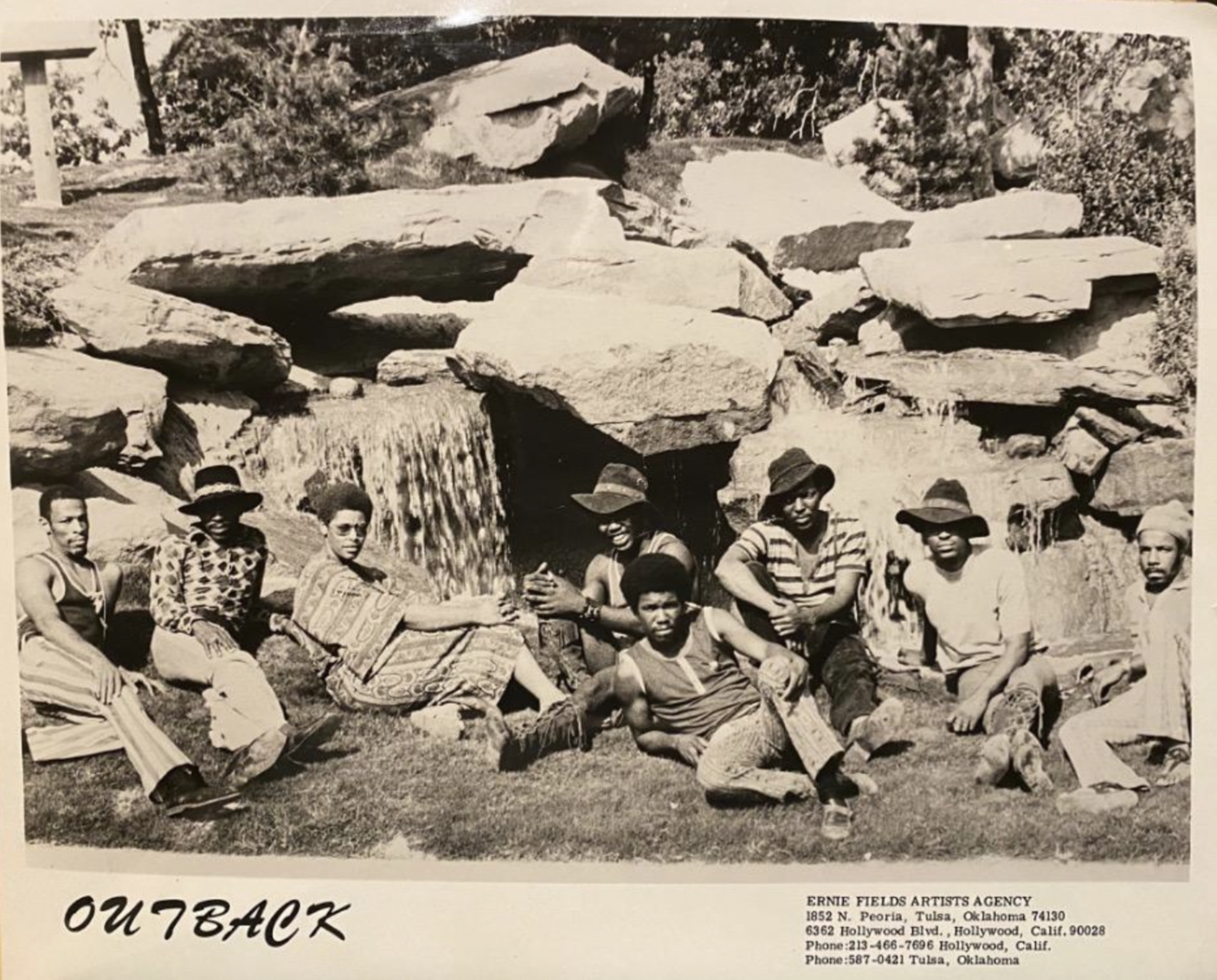
Outback once attempted a photo shoot in a creek bed at Flat Rock Creek in north Tulsa. Dabney recalled, “Armed white men came up in trucks and chased us out. They pointed guns at us and said things that were unprintable and racist and told us to get out of the creek. Our photographer was a white hippie guy, and we just scrambled. We ended up in Gilcrease Hills and took the picture there.” Despite that experience, the band continued to perform and build community through music.
Personnel changes eventually reshaped the group. Ronnie Wilson left to take a job at a drugstore to provide for his family, and his younger brother, Charlie Wilson, joined Outback, marking his first professional musical experience. Dabney said Charlie’s entry into the band required family approval, and at the time, they told his parents he was going to a drum major clinic in Kansas City, with Dabney as his chaperone. “I backed that story up,” Dabney chuckled, recalling the story. “That’s how he was able to go.”
Instead of attending a music clinic, Wilson traveled with Outback to Kansas City, where the band performed a two-week gig at Flanker’s Lounge. The club was owned by Otis Taylor, the Kansas City Chiefs star then known as a flankerback, now called a wide receiver.
Dabney loves telling that story, especially given how far that initial lie actually carried things. Decades after sneaking off to Kansas City, Grammy-nominated R&B and funk singer, songwriter, and record producer “Uncle Charlie” Wilson, as he’s called now, received his star on the Hollywood Walk of Fame in 2024. For Dabney, it’s a proud connection to a career that shaped generations of music—from Charlie’s days fronting The Gap Band on tracks like “You Dropped a Bomb on Me” to his later years as a featured guest artist for Snoop Dogg, Kanye West, Bruno Mars, and Justin Timberlake. Thirteen Grammy nominations and a Billboard Lifetime Achievement Award later, it all traces back to those early R&B and funk days in Tulsa.
During this period with Outback, Dabney became known for extended, 15-minute drum solos that frequently became highlights of the band’s live shows. “The rest of the band would walk offstage and change clothes and be back before I was finished with my drum solo,” he said with a laugh.
This high-energy showmanship earned Outback an invitation to perform on Dr. Mazeppa Pompazoidi’s Uncanny Film Festival and Camp Meeting on KTUL Channel 8. The show, created and hosted by Gailard Sartain, was an avant-garde, surrealist riot that smashed the rules of 1970s television, featuring a pre-fame Gary Busey on drums and, occasionally, a disguised Leon Russell.
When Outback took the stage, they leaned entirely into the energy. “I launched into the solo, launched my sticks into the air, grabbed another pair, and finished the whole thing beating on the drums with my bare hands,” he recalled. He kept the solo going even as everyone else exited the stage—the perfect soundtrack to beautiful, televised mayhem.
Outback looked to expand beyond Oklahoma. The group began touring throughout the United States, but its plans changed during a performance in Texas. “We were playing a show in Fort Worth, Texas,” Dabney recalled. “Producer Buck Ram walked up to our singer, Willie Lewis, and invited him to join The Platters,” one of the most successful vocal groups of the era. Lewis accepted the offer. Ram promised the remaining members of Outback a major-label recording contract, but the deal never materialized. Without further recording opportunities, the band stopped making records, leaving the 1972 single as its only studio release.
Though their time together eventually ended, the experience helped shape future paths, including Charlie Wilson’s rise with the Gap Band and his later international success. Lena Luckey Wilson later toured with Leon Russell and the Gap Band.
Civil Rights and a Higher Calling
By the late 1960s, Dabney became involved in civil rights organizing, including training and work connected to the Black Panther Party, and set up the National Committee to Combat Fascism in Tulsa. He was the first Black Panther in Tulsa. His activism, combined with some bad choices, eventually led to his arrest. After that experience, he chose to step back from street-level organizing and work within community systems instead.
Dabney’s friend, Willie Lewis, had retired from singing and moved back to Tulsa to work as a public information officer for the Tulsa Sheriff’s Department. Lewis was also a man of faith and the founding pastor of Redeemed by Grace Church. Lewis served as a chaplain for the Sheriff’s Office and brought Dabney into the Tulsa Police Chaplaincy Corps, a role that reflected Dabney’s shift toward mediation, service, and community support. During this period, he also moved into media production, working out of Greystone Studio and producing Christian television programming.
Greystone Studio, The Church Studio, and a Turning Point
When Leon Russell returned to Tulsa in the early 1970s, he transformed a former church at Third and Trenton into The Church Studio, making it both Shelter Records’ headquarters and a creative hub for the emerging Tulsa Sound. The building became a gathering point for musicians moving between north Tulsa’s clubs, regional touring circuits, and national recording work. In that period, it stood at the center of a broader musical exchange where Black R&B, gospel, blues, rock, and country influences continually overlapped.
It was natural for Russell to head into Tulsa’s Black music scene, hanging out and collaborating with local artists. He enjoyed returning to the north Tulsa clubs where he had performed and snuck in as a teenager. He was also interested in producing and signing new musicians, which led him to cross paths with the Wilson brothers at the International Club. After meeting their family and gaining their mother’s approval, Russell signed the group to Shelter Records in 1974. He shortened the band’s name from the Greenwood, Archer, and Pine Street Band to the Gap Band. The group first appeared as Russell’s backing band on his 1974 album Stop All That Jazz before recording its own debut release, Magician’s Holiday.
That continuity is significant. The Church Studio’s early years under Leon Russell helped define a sound rooted in Tulsa’s Black musical traditions, while its later use as Greystone reflects how those same spaces continued to evolve alongside the people who passed through them. In Dabney’s case, it marks the point where performance, production, and ministry began to merge into a single path.
That period was also connected directly to his work with Mother Grace Tucker, a transformative figure in Tulsa’s faith and outreach community. Tucker, known for her tireless ministry to the unhoused and her advocacy for the vulnerable, recognized Dabney’s commitment and later ordained him in 1985 after his first sermon. Her influence remained central to his understanding of service, discipline, and community responsibility.
In 1987, while working at a Christian radio station in Sapulpa, Dabney met his wife, Sarah. They married the following year and co-founded Spirit Fire Ministries International, continuing their shared work in ministry and outreach for more than three decades.
Late Career, Relocation, and Continued Work
After years of ministry and media work in Tulsa, Dabney eventually relocated to California with his family, where he continued his work in broadcasting and production. In California, he expanded his media career, including work in television operations at Trinity Broadcasting Network and independent studio production, while maintaining his role in ministry.
Later, he and his wife, Sarah, moved to Arizona, where they faced significant hardship during their transition, including a period of homelessness. They lived in a van before eventually re-establishing housing and rebuilding stability. Despite these challenges, Dabney continued his ministry, focusing on outreach, veterans’ support, and community engagement, including over a decade as the chaplain for the Rim Country Detachment 928 of the Marine Corps League.
Prophet Bishop Sarah Dabney died of Covid-19 on Christmas morning, 2021, with Dabney by her side. He took comfort in remembering, “More than anyone I’ve ever known, she was ready to meet God.”
During this period, he also continued to perform and teach, maintaining a connection to the musical foundation that had shaped his life in Tulsa. His work increasingly bridged music, ministry, and storytelling as interconnected forms of service.
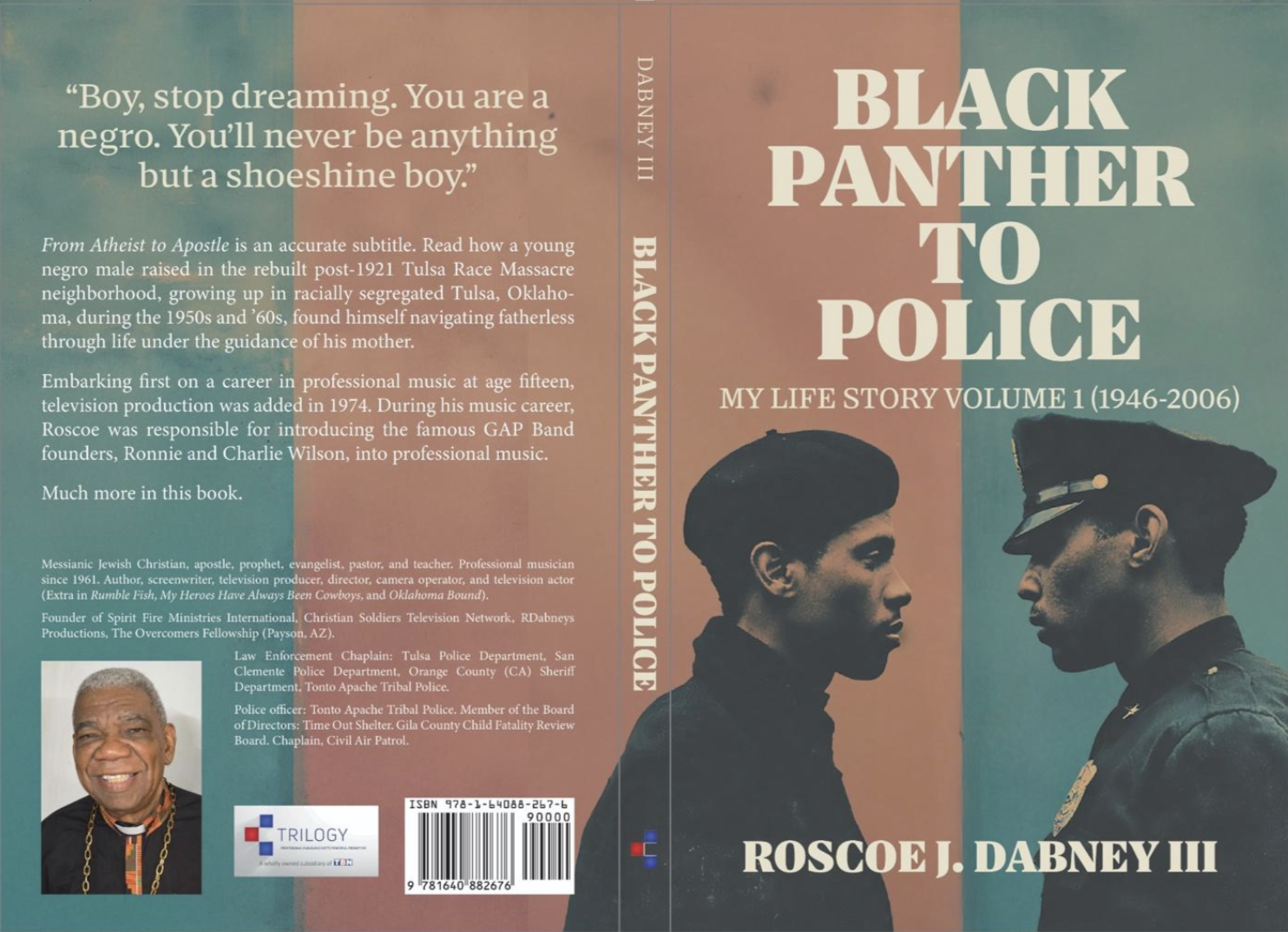
Dabney’s life story has since been documented in several publications, including From Black Panther to Police (Trilogy Christian Publishing Co.) and contributions to the Imprints of Honor oral history project. He is also working on a second book, Easy Street and Beyond, which continues his personal and spiritual journey, including the period of rebuilding life and ministry in Arizona.
Tulsa’s Unfinished Chapter
It isn’t that Tulsa is the only place where these traditions came together—cities across the country have their own versions of churches, clubs, touring circuits, and Black musical life, where styles continually blend and evolve. What makes Tulsa distinct is how these elements converged locally to form what became known as the Tulsa Sound and how that story has often been told without fully accounting for the Black musicians who helped shape its foundation.
Under the label is a deeper history rooted in north Tulsa’s musical life—church bands, neighborhood clubs, school programs, and touring R&B circuits—where the grooves, performance styles, and musical language that later defined the Tulsa Sound were already taking shape. J.J. Cale and Leon Russell both spent time in North Tulsa and were exposed to that environment firsthand, even as they developed their own distinct artistic paths.
The Living Trajectory
Tulsa has this deep musical history, built by Black artists and roots musicians who created something completely unique. That original foundation is still right beneath the surface at places like The Church Studio, pushing local music into all kinds of new directions. You can hear that same independent streak whether you’re listening to new indie rock, the thriving Americana scene, or the artists creating the next wave of Black music here right now.
The Tulsa Sound endures less as a fixed genre and more as a regional feel, appearing in blues, Americana, rock, soul, jazz, hip-hop, and even spoken word across Oklahoma and beyond. Steve Ripley and The Tractors carried elements of that sound into country rock. The heavy blues guitar of Seth Lee Jones, the finger-picking blues of Tom Pevear, and veteran local acts like Bubba Blues of Tulsa have kept a raw, Tulsa-rooted blues tradition alive. That lineage continues directly through Tory Ruffin—guitar legend for Morris Day and the Time—whose project Freak Juice fuses heavy blues, funk, and rock into a modern Tulsa groove alongside the Paul Benjaman Band. Many of these musicians can be found on Tulsa’s nonprofit label, Horton Records, and in various clubs and festivals almost daily.
Expanding the Legacy
Projects like Fire in Little Africa, which brought together more than 50 Tulsa musicians, poets, rappers, producers, DJs, and spoken-word artists, reflect this ongoing evolution. Rather than defining a single style, the project highlights a collaborative tradition long central to Black music in Tulsa—one built on shared creation, community, and reinvention. Artists such as Steph Simon and O’Maley B draw on the city’s broader cultural memory, linking music, storytelling, and lived experience in ways that reflect the continued expansion of Tulsa’s sound.
Steve Liddell continues the Tulsa Sound tradition by blending folk, rock, country, Americana, reggae, jazz, and blues into a relaxed, steady, rhythmic foundation. He captures the collaborative spirit of the original sound by performing both as a frontman for his bands, the String Lifters and Boot Scootin’ Boogie, and as a supporting bassist for other local artists. Through his original songs and his work managing The Shrine, a staple local music venue, he helps keep Tulsa’s roots music culture alive today.
Alongside these newer voices, cornerstone figures such as Booker Gillespie have helped sustain Tulsa’s musical heritage through performance, education, and cultural advocacy, ensuring that earlier traditions remain vital in the city’s living music scene. What unites these artists is not a single sound but a shared lineage. From north Tulsa’s clubs and churches to modern studios and collective projects, the music has never stopped evolving. It has shifted forms, crossed genres, and spanned generations, yet it continues to carry the same pulse.
The Tulsa Sound, in that sense, is not a finished chapter. It is an ongoing conversation—still.
We’d like to give a special thank you to Roscoe Dabney III and his son, Roscoe Dabney IV. Their personal stories, photos, and insights were absolutely essential to bringing this important part of Tulsa’s music history to life.